Fire Safety for Holiday Lets, Airbnb’s and Small Guest Accommodation

If you run a holiday let, Airbnb, B&B, guest house, or short-term rental, fire safety is your legal responsibility. Many people think fire safety rules only apply to hotels, but if you charge guests to stay in your property and it is not being used as a private home, the law usually applies to you under the Regulatory Reform (Fire Safety) Order 2005. Even if guests only stay for one night, you must help keep them safe from fire. This includes: Do You Need a Fire Risk Assessment? In short, yes. A fire risk assessment helps identify what could cause a fire, who is at risk, how people would escape, and what safety improvements are needed. As guests are unfamiliar with your property, fire safety is even more important in short-term lets. Your assessment should be written down and reviewed regularly, especially after changes such as renovations or a fire. Main Considerations Electrical Safety Electrical faults are one of the biggest causes of fire. Make sure that the fixed wiring is checked every 5 years, referred to as an Electrical Installation Condition Report (EICR), appliances are safe and regularly inspected, sockets and cables are not damaged, and any extension leads are kept to a minimum. Cooking Kitchen fires are also common. You should keep cookers and appliances clean and service gas appliances every year. Clear and simple instructions should also be given to guests, with extractor filters cleaned regularly. Smoking and Candles Smoking is a major fire risk, and a clear policy should be in place in your property. The safest option is to inform guests that smoking is not permitted indoors. This should be reinforced with clear ‘No Smoking’ signs displayed in the property, with the option for an ashtray, should there be an outside space. You should also avoid candles and tea lights for guests, as these are a common cause of fires and can easily be misused and left unattended. Smoke Alarms and Escape Routes Most small guest properties need hardwired, interlinked smoke detection systems that include a heat detector in the kitchen. Escape routes should be kept clear of trip hazards, and guests should be able to leave quickly without needing keys to unlock exit doors from inside. Fire Doors Fire doors are an important part of keeping guests safe. Their job is simple: to slow down the spread of fire and smoke, giving guests more time to escape safely. In many small properties, solid, well-fitting doors may be acceptable, especially if they protect hallways, staircases, and escape routes. You do not automatically need to upgrade all the doors within your property. However, thin hollow doors or damaged doors usually do not provide enough protection and may need to be replaced with proper fire-resistant doors. You should also make sure fire doors close properly, and information is provided to guests to keep doors closed at night, especially kitchen and lounge doors. In some cases, especially in flats or larger properties, self-closing fire doors may also be needed. Fire extinguishers Fire extinguishers may be provided within the property; however, issues may arise with regard to training and any misuse. It is usually safer to evacuate a premises than expect guests to stay behind and tackle a fire themselves. A simple fire blanket may also be provided. Fire Safety Information for Guests An information pack should be available to guests informing them what they should do if a fire were to start and where the nearest exit is. This can be in the form of a Fire Action Notice and should detail how to call 999, along with the full property address. Regular Fire Safety Checks As a property owner, you should ensure that the fire safety systems within your property are tested regularly. This includes smoke alarms, emergency lighting, fire extinguishers, fire doors, and escape routes. Keeping records of checks helps show you are compliant. Protect Your Guests and Your Business Fire safety protects more than just your building. It protects your guests, your reputation, and your business. The government has published official guidance for owners of small paying guest accommodation, including holiday lets, Airbnb’s, B&Bs, and guest houses. It covers fire risk assessments, smoke alarms, fire doors, escape routes, and your legal responsibilities under fire safety law. You can read the full guide here: https://www.gov.uk/government/publications/making-your-small-paying-guest-accommodation-safe-from-fire This is a useful starting point, but many property owners still benefit from a professional fire risk assessment to make sure their specific premises are fully compliant. If you are a property owner in need of a fire risk assessment, contact us today for a free quote and get the peace of mind your business needs.
What Fire Extinguisher Do I Really Need?
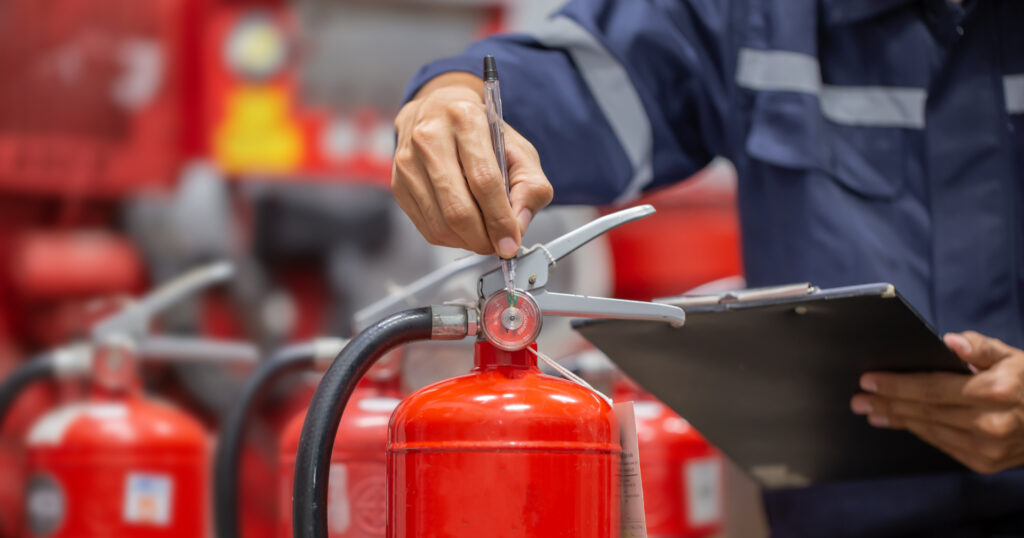
Choosing the correct fire extinguisher is an important part of fire safety for businesses, landlords, and property managers. Many premises have extinguishers installed, but not everyone understands which type is actually suitable for their risks. Using the wrong extinguisher can make a fire worse or place people in danger. The correct selection and positioning of extinguishers in the UK should follow the guidance as set out in British Standard 5306. Fire Classes Explained Fire extinguishers are designed for specific types of fire. Understanding the likely fire risks in your building is the first step in choosing the correct extinguisher. Main Types of Fire Extinguishers Water Fire Extinguishers Suitable for: Not suitable for: Class A fires Class B fires Class D fires Electrical fires Class F fires They work by cooling the burning material until the fire is extinguished. A minimum of 2 Class A extinguishers are generally needed per floor, with the exact quantity set out in BS 5306-8. Foam Fire Extinguishers Suitable for: Not suitable for: Class A fires Class B fires Class D fires Electrical fires Foam forms a blanket over burning liquids, cutting off oxygen and helping prevent reignition. Environmental Changes There has been growing attention around the environmental impact of some firefighting foams. Certain older foams containing PFOA (a PFAS “forever chemical”) are now restricted in the UK. Many modern extinguishers now use C6 chemistry or fluorine-free foam, which are designed to reduce environmental impact. If you are unsure about older foam extinguishers on site, a competent fire safety company can check whether replacement is required. CO₂ Fire Extinguishers Suitable for: Not suitable for: Class B fires Electrical fires Class A fires Confined spaces They work by displacing oxygen and cooling the fire. Because CO₂ leaves no residue, they are ideal for offices, IT rooms, and areas with sensitive electronics. Dry Powder Fire Extinguishers Suitable for: Not suitable for: Class A fires Class B fires Class C fires Electrical fires Confined spaces These are generally not recommended for enclosed spaces such as offices because the powder can impair visibility and breathing. Wet Chemical Fire Extinguishers Suitable for: Not suitable for: Class A fires Class F fires Class B fires Class C fires Electrical fires They cool the fire and form a sealing layer over hot oil to prevent re-ignition. They are predominantly used in commercial kitchens and the quantity and rating needed depends on the surface area of where the cooking takes place. Anything greater than 0.4m2 will generally need a fixed extinguishing system. Alternative Fire Extinguishers In addition to the traditional types above, there are some newer technologies used in certain environments. Water Mist Extinguishers Suitable for: Not suitable for: Class A fires Some Class B fires Class C fires Electrical fire Some Class F fires Some Class B fires Some Class F fires Water mist extinguishers use very fine water droplets to cool the fire and reduce oxygen around the flames. Because they use de-ionised water and produce a fine mist, they can be useful in sensitive environments such as hospitals and heritage buildings. Some water mist systems may be tested to European standards, but they are not always covered in the same way under the traditional guidance within BS 5306, so suitability should always be assessed as part of the fire risk assessment. P50 Service-Free Extinguishers P50 extinguishers are composite-bodied extinguishers designed to reduce servicing requirements. Manufactured by Britannia Fire Ltd, these extinguishers are marketed as requiring visual inspection rather than annual servicing for up to 10 years. The P50 range consists of Water, Foam and Wet Chemical extinguishers to tackle a range of fire classes. While P50 extinguishers meet product standards, their maintenance regime differs from traditional servicing under BS 5306-3, which normally requires annual servicing by a competent technician. Because of this difference, organisations should carefully consider whether this approach aligns with their fire safety management and risk assessment. Fire Extinguisher Maintenance Installing extinguishers is only part of the requirement. They must also be maintained to ensure they work when needed. Under BS 5306-3, this typically includes: Proper maintenance ensures the extinguisher remains safe and operational. The Bottom Line There is no single extinguisher suitable for every environment. The correct type depends on the specific fire risks within the building. Ensuring extinguishers are correctly selected, positioned, and maintained in accordance with British Standards is essential for protecting people, property, and remaining compliant with UK fire safety legislation. If you are unsure which extinguishers are appropriate for your premises, a fire risk assessment should always be the starting point.
A New Chapter in Fire Safety: The Fire Safety (Residential Evacuation Plans) (England) Regulations 2025
England is introducing a major new fire safety law to improve how people in residential buildings are protected and supported if a fire breaks out. The Fire Safety (Residential Evacuation Plans) (England) Regulations 2025 will come into force on 6th April 2026 and will impose legal duties on building owners/managers in specified residential buildings to plan for the safe evacuation of people who may struggle to escape without help, alongside building-wide evacuation plans. Which buildings do they apply to? The new Regulations will apply to residential buildings that have two or more domestic dwellings, and are: What the Regulations Require Once a building is in scope, the Regulations place several interlinked duties on the “Responsible Person” (typically the building owner or manager): Who does this help? The Regulations give statutory force to a process known as Residential Personal Emergency Evacuation Plans (Residential PEEPs) aimed at making fire safety planning more inclusive and tailored to individual needs. These duties implement recommendations from the Grenfell Tower Inquiry on evacuation planning and seek to ensure residents with mobility, sensory, or cognitive challenges are not overlooked in fire plans. Looking Ahead As April 2026 approaches, owners and managers of high-rise and higher-risk residential buildings must prepare now. They should check whether their buildings are in scope, engage with residents, and begin to set up processes to meet their legal obligations. Residents should also understand their rights under the Regulations, including the voluntary nature of participation and the protections for personal consent and data. If you require any fire safety services, Florian Fire Safety is here to help. We offer assistance with Fire Risk Assessments, PEEPs, and other types of fire safety requirements.
Enforcement and Prohibition Notices: What You Need to Know

Fire safety enforcement in the UK is a serious matter. If a business or building owner fails to comply with fire safety legislation, the local Fire and Rescue Authority has the power to take formal action. Two of the most significant tools available to enforcing authorities are Enforcement Notices and Prohibition Notices. Understanding what these notices mean, what to do if you receive one, and who to involve can make a critical difference to both safety and business continuity. What Is an Enforcement Notice? An Enforcement Notice is issued when the Fire Authority believes that the Responsible Person has failed to comply with one or more requirements of the Regulatory Reform (Fire Safety) Order 2005. Common reasons include: Importantly, an Enforcement Notice does not usually mean there is an immediate danger to life, but it does indicate that fire safety standards are inadequate and must be improved. A deadline will be provided by which the work or actions must be completed. What Is a Prohibition Notice? A Prohibition Notice is far more serious. It is issued when the Fire Authority believes there is a risk so serious that the use of the premises should be restricted or stopped altogether. Common reasons include: A Prohibition Notice may prohibit the use of all or part of a building and takes effect immediately due to the high risk. It will remain in place until the risk has been reduced to an acceptable level. Appeals: Can You Challenge a Notice? Yes, both Enforcement and Prohibition Notices can be appealed. However, due to the legal and technical complexity, legal and professional advice is strongly recommended before appealing. Appeals for both Notices must be made to the Magistrates’ Court and within 21 days of the Notice being served. The difference between the two Notices is that an Enforcement Notice will be suspended during the appeal process; however, a Prohibition Notice will remain in force during the appeal process. What Should You Do If You Receive a Notice? Receiving any formal fire safety notice can be stressful, but how you respond is crucial:
Fire Risk Assessments Aren’t Optional – They’re Essential.

A fire risk assessment is one of the simplest and most effective ways to protect your people, property and business continuity. While it’s easy to think of fire safety as something that only matters in an emergency, the truth is that a well-planned assessment works quietly in the background every day, reducing risks long before flames ever appear. What is a Fire Risk Assessment? A fire risk assessment is a systematic look at your premises to identify potential fire hazards, the people who may be at risk, and the measures needed to prevent fire and ensure safe evacuation. It typically involves: The outcome is a clear action plan that highlights what’s working well and what needs improvement. Significance Fires don’t just cause property damage; they can lead to business downtime, financial loss and serious harm. A strong fire risk assessment: The Regulatory Reform (Fire Safety) Order 2005 also makes fire risk assessments a legal requirement for almost all non-domestic premises. The responsibility sits with the “responsible person” – usually the employer, building owner or manager – to ensure the assessment is completed and kept up to date. Wrapping Up A well-designed fire risk assessment does more than tick a compliance box. It creates safer spaces, empowers staff, and helps protect what matters most. By investing time in understanding your risks and addressing them, you significantly reduce the chances of ever needing to face the real thing.
The Fire Safety Order 2005 and the Fire Safety Act 2021: An Overview

Fire safety is a vital part of protecting people, property, and businesses. In the UK, two key pieces of legislation define how fire safety is managed: The Regulatory Reform (Fire Safety) Order 2005 and The Fire Safety Act 2021. Together, these laws establish a robust framework for assessing and managing fire risks in buildings, with a focus on accountability and prevention. The Regulatory Reform (Fire Safety) Order 2005 The Fire Safety Order 2005 applies to all non-domestic premises in England and Wales, including workplaces, public buildings, and the communal areas of multi-occupied residential premises. The Order designates a “responsible person” — typically the employer, building owner, or managing agent who must: Failure to comply with the Fire Safety Order can result in enforcement action, including fines or prosecution. The Fire Safety Act 2021 The Fire Safety Act 2021 was introduced to strengthen and clarify the scope of the Fire Safety Order, particularly in response to the Grenfell Tower tragedy. The Act makes explicit that, in multi-occupied residential buildings, the fire risk assessment must include consideration of: This clarification ensures that those responsible for building safety address all elements that could contribute to the spread of fire. Why It Matters? Together, these laws aim to make buildings safer and ensure that those in charge of premises take proactive steps to prevent fire risks. Regular assessments, good communication, and clear safety procedures are not just legal requirements—they’re vital to saving lives.
Stop the Spread: How Compartmentation Saves Lives in a Fire

In the UK, fire safety regulations are underpinned by a principle that’s often overlooked outside the industry – compartmentation. It’s a cornerstone of passive fire protection, designed not just to protect buildings, but more importantly, to save lives. What is Compartmentation? Compartmentation is the practice of dividing a building into separate fire-resisting compartments. These are typically constructed using fire-resistant walls, floors, ceilings, and doors. The goal? To contain fire and smoke within a specific area, limiting its spread and allowing more time for evacuation and emergency response. Why is it Critical? Legal Requirements in the UK Under the Regulatory Reform (Fire Safety) Order 2005, building owners and responsible persons must ensure that fire compartmentation is maintained and effective. Additionally, the Fire Safety (England) Regulations 2022 place increased emphasis on fire door inspections and the performance of passive fire protection systems, especially in high-rise and high-risk buildings. Common Issues Final Thoughts Compartmentation isn’t just a box-ticking exercise: it’s a life-saving strategy built into the very fabric of a building. Regular inspections, proper installation, and awareness are all key to ensuring it works when it matters most. If you’re responsible for a building, ensure your fire strategy includes robust compartmentation, and don’t wait for a fire to test it. Contact Florian Fire Safety today if you have any questions about compartmenation!
Fire Safety (England) Regulations 2022
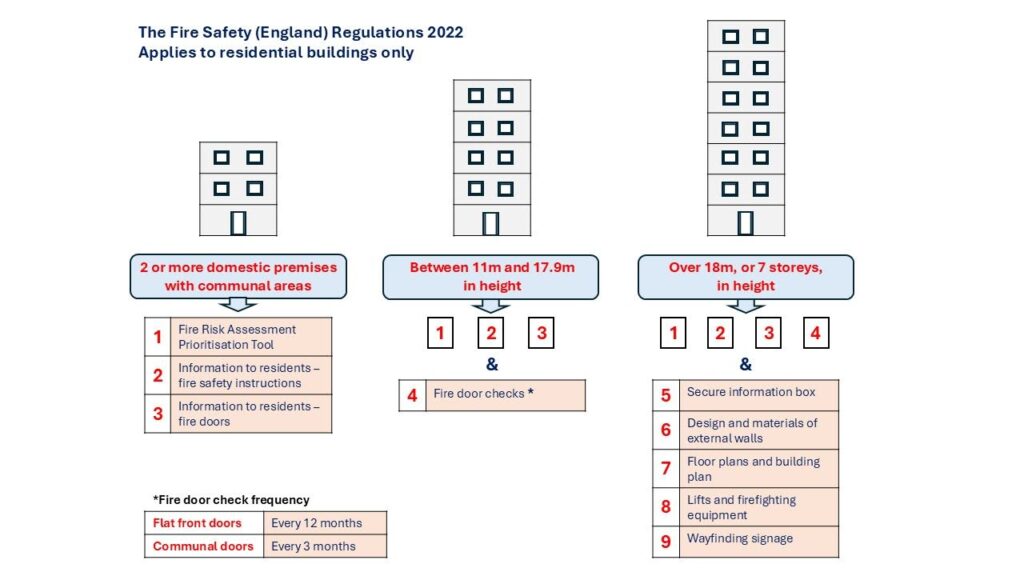
The Fire Safety (England) Regulations 2022 came into force on 23 January 2023 and are centred around the additional fire safety measures required in residential buildings. The fire safety measures required depend on the building’s height. For any multi-occupied residential building with two or more domestic premises, the Regulations require that the Responsible Person (RP): For residential buildings over 11m in height, the Regulations also require that the RP: In addition to the above, Regulations require that the RP of high-rise residential buildings (over 18m or seven storeys): By implementing these regulations, the goal is to enhance fire safety, improve response times, and better protect residents in multi-occupied buildings.