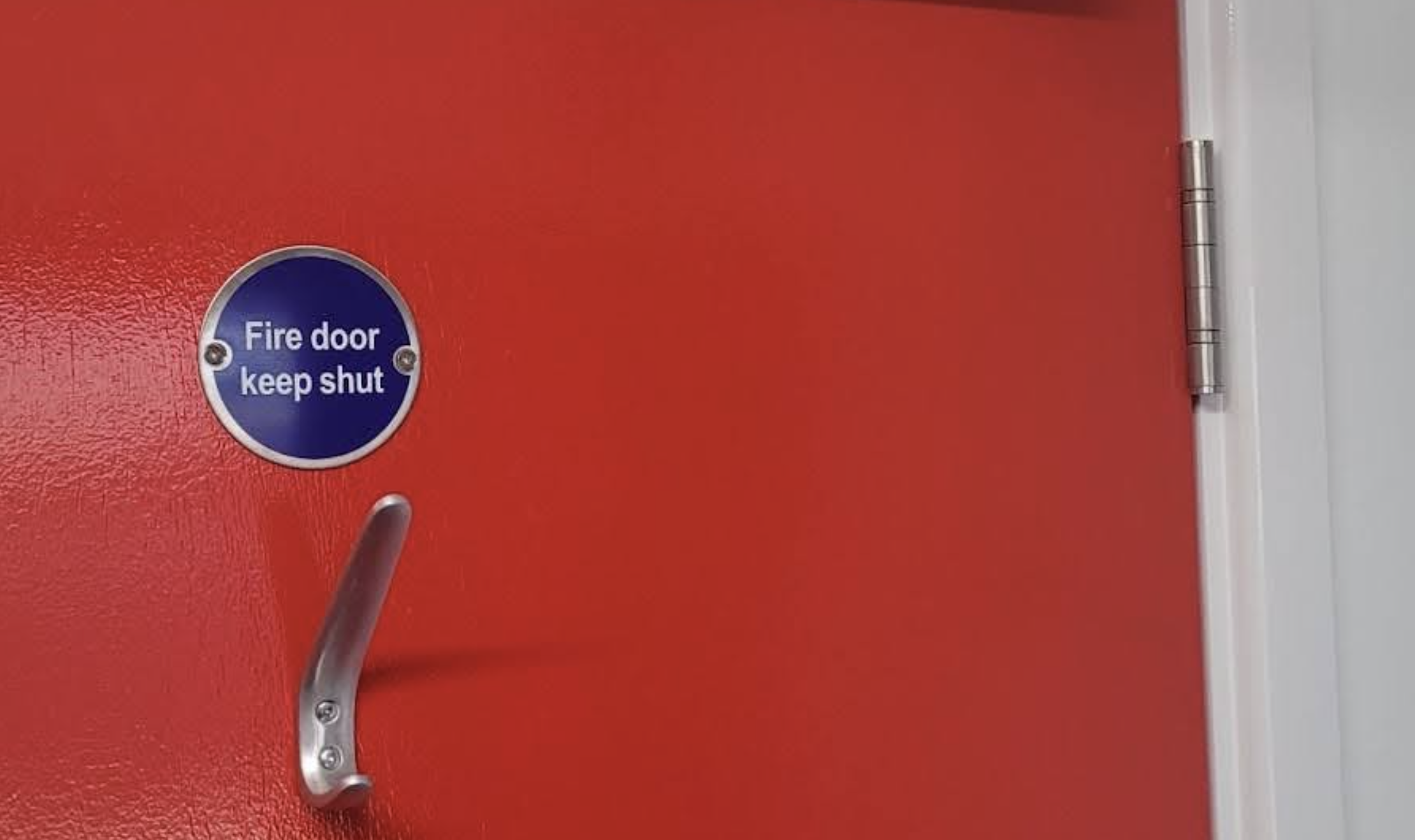
Fire doors are one of the most important elements of passive fire protection. When correctly specified, installed, and maintained, they help restrict the spread of fire and smoke, protect escape routes, and provide occupants with valuable time to evacuate.
However, fire doors are often misunderstood. An older door does not automatically need replacing, a door with a certification label is not necessarily satisfactory, and simply adding intumescent strips does not automatically turn an existing door into a compliant fire door. The suitability of a fire door depends on its construction, condition, location, required performance and the evidence available to support it.
Fire Door Requirements and Inspection
The requirements surrounding fire doors have developed considerably over the years. Older buildings may contain doors manufactured to standards and practices that differ significantly from those used today. Terms such as notional, nominal, and certified are commonly used when describing existing fire doors.
A notional fire door is generally an older door whose fire-resisting performance is inferred from its construction and the standards applicable when it was installed. A nominal fire door is usually a door considered capable of providing a degree of fire resistance based on its construction, but without sufficient test or certification evidence to confirm its exact performance. A certified fire door has supporting evidence demonstrating its tested fire performance.
The absence of modern certification does not automatically mean that an older fire door is unsuitable. Existing doors should be assessed in the context of the building, their condition, construction and the level of fire resistance required. Government guidance recognises that doors manufactured to earlier standards may continue to provide suitable protection where they remain in good condition and are appropriate for their location.
Legal requirements
The Regulatory Reform (Fire Safety) Order 2005 (FSO) places important duties on the Responsible Person.
Under Article 9, the Responsible Person must undertake a suitable and sufficient fire risk assessment. This should consider the adequacy of the building’s fire precautions, including fire-resisting doors where they form part of the means of escape or compartmentation.
Under Article 17, fire safety equipment, facilities and devices provided for the safety of relevant persons must be subject to a suitable system of maintenance and maintained in an efficient state, efficient working order and good repair. Fire doors form an important part of the building’s passive fire protection and therefore need to be appropriately maintained.
For multi-occupied residential buildings where the top story is more than 11 meters above ground level, the Fire Safety (England) Regulations 2022 introduce specific fire door inspection requirements. The Responsible Person must use best endeavours to check flat entrance fire doors at least every 12 months, and communal fire doors at least every three months. These checks are in addition to the wider requirements of the FSO.
Buildings below 11 metres, and other types of premises, are not exempt from maintaining their fire doors. The appropriate inspection and maintenance regime should be determined through the fire risk assessment and based on the risks associated with the building.
It is also important to distinguish between routine fire door checks and a detailed fire door survey. The statutory checks required by the Fire Safety (England) Regulations are intended to identify obvious defects and confirm that doors remain in good condition and working order. They are not a substitute for a detailed assessment of the suitability or fire performance of the doors.
Routine checks should look for obvious issues such as damaged door leaves or frames, missing or damaged seals, excessive gaps, defective self-closing devices, damaged hinges or hardware, and doors being wedged or propped open. The frequency of additional checks should reflect the building and the level of use and wear experienced by the doors.
Fire Door Surveys, Components and Upgrading
A fire door is a complete door set, not simply a door leaf. Its performance can be affected by the door leaf, frame, hinges, latch or lock, self-closing device, intumescent and smoke seals, glazing, letterboxes, threshold and the surrounding wall construction.
A detailed fire door survey considers these components and records the condition of individual doors. It may also consider door gaps, evidence of certification, construction, previous alterations and whether the doors are appropriate for their location.
The survey should provide a clear schedule of defects and identify whether doors require maintenance, repair, upgrading or replacement.
Not every defective or uncertified door needs to be replaced. In some circumstances an existing door can be appropriately repaired or upgraded. However, upgrades should only be undertaken where there is suitable evidence that the proposed materials, components and method of installation are compatible with the particular door and capable of achieving the required performance. Simply adding intumescent strips to an old door does not, by itself, make it an FD30 or FD30S door.
Where an existing door cannot reasonably be demonstrated to provide the required level of fire resistance, replacement with an appropriately specified and certified door set may be necessary.
The latest British Standard specifically covering fire-resisting and smoke-control doors is BS 8214:2026 – Fire-resisting and smoke control doors – Practical considerations concerning specification, design and performance in use – Code of practice. It provides guidance covering the specification, design, installation and maintenance of fire-resisting and smoke-control doors.
Fire door inspections and surveys should be undertaken by people with an appropriate level of knowledge, skills and experience for the work being carried out. A straightforward routine check does not necessarily require the same level of competence as a detailed fire door survey. Where the age, construction, certification or performance of doors is uncertain, specialist competence may be required.
Ultimately, fire doors should not be assessed in isolation. They form part of the building’s overall fire strategy and compartmentation. A new certified door will not compensate for defective surrounding walls, missing fire stopping or other significant compartmentation defects.
The key message is simple: an old fire door is not automatically an unsafe fire door, and a new fire door is not automatically a satisfactory one. The condition, construction, evidence, installation, maintenance and location of the doors all need to be considered.
For Responsible Persons, landlords and building managers, appropriate routine checks, periodic detailed surveys and effective maintenance arrangements are essential to ensure that fire doors remain capable of performing their intended function when they are needed most.